- Which measure is it: handle, gross revenue or a taxable figure after deductions?
- Which period: calendar month, calendar year, or a fiscal year such as July to June or April to March?
- Does it include promotions, and are they deductible in that jurisdiction?
- Is it the regulator's own number, or a trade body or press calculation?
To read a gambling revenue report correctly, check four things before quoting any number: the measure, the period, the treatment of promotions and who published it. Then look for two less obvious traps, restatements and missing operators. The examples below come from releases we used on this site in October 2026; where one comes from trade press rather than the regulator, we say so.
1. Name the measure
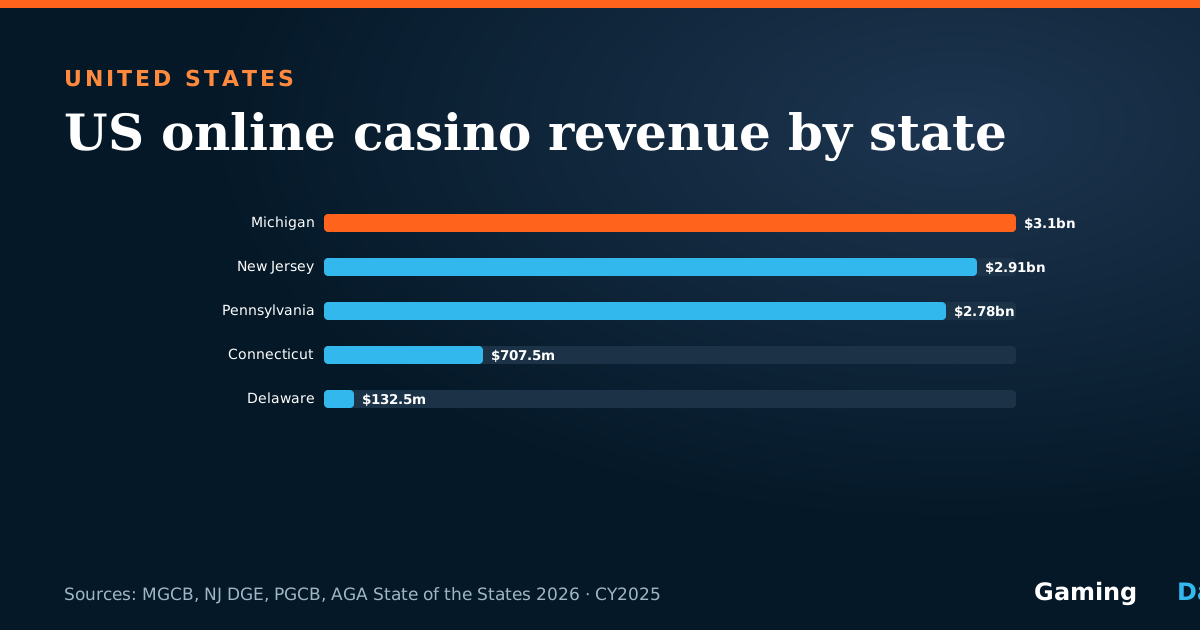
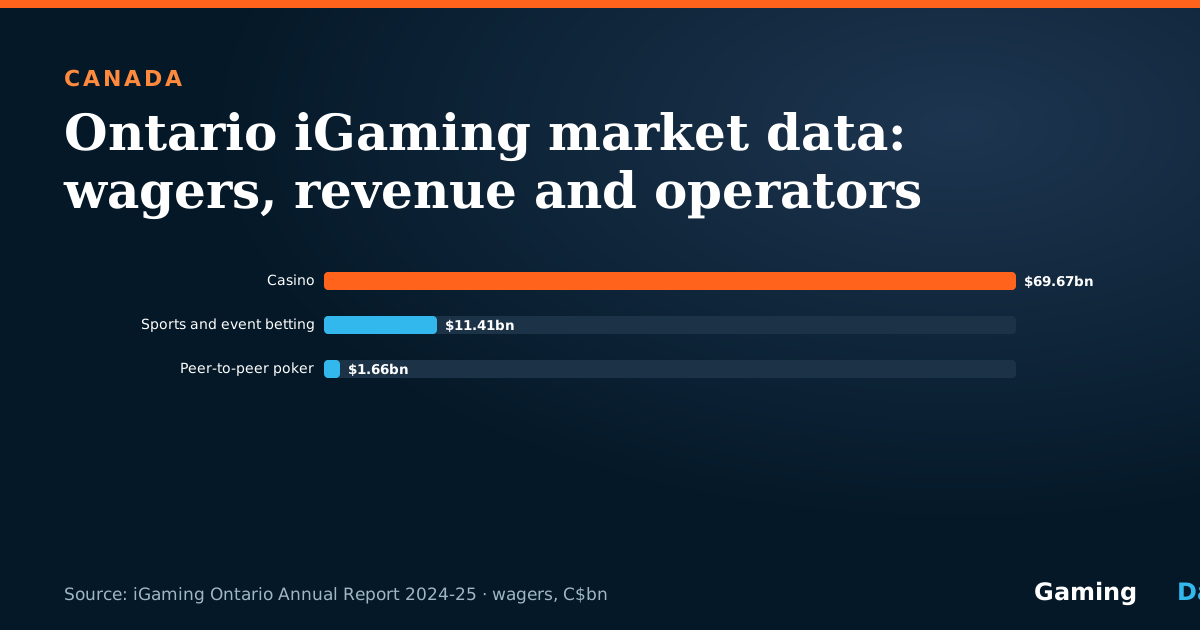
The same activity can produce several revenue figures. Michigan's online casinos reported $3.1 billion in gross receipts and $2.9 billion in adjusted gross receipts for 2025; the second is the tax base after allowable free play. Pennsylvania's Gaming Control Board reported $2.78 billion of online casino revenue, while the American Gaming Association lists about $3.46 billion, apparently before promotional deductions. Ontario's FY2024-25 revenue appears as C$2.9 billion in the audited annual report and about C$3.2 billion on the market performance basis, as reported by trade press. None of these is wrong. Each is a different measure, and mixing them in one chart produces false growth or false rankings. Our glossary of handle, GGR and related terms explains each measure.
2. Check the period
Fiscal years catch people out. Pennsylvania, West Virginia, Colorado, Maryland, Illinois, Delaware and Rhode Island headline July to June totals. Ontario, the UK Gambling Commission and most Canadian lottery corporations use April to March. New York's sports wagering data comes weekly, ending on Sundays, so 52 weeks do not match a calendar year exactly; our 2025 New York total runs from 30 December 2024 to 28 December 2025. To build a calendar year from fiscal data you need monthly figures, or arithmetic on fiscal year-to-date totals, which we label as our calculation.
3. Find out how promotions are treated
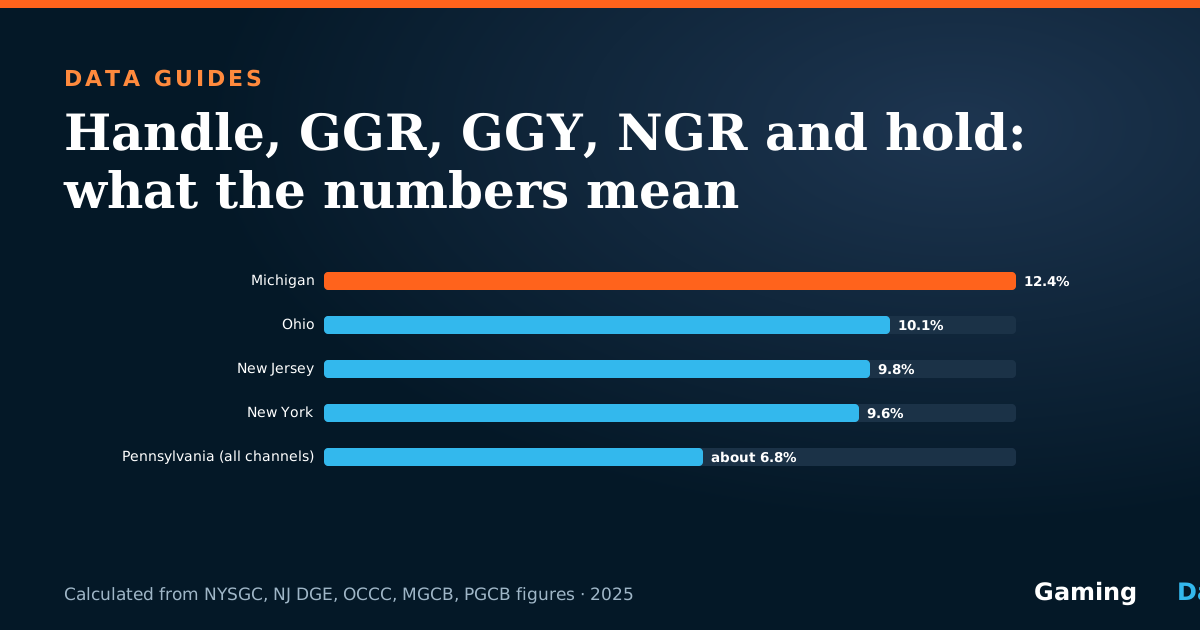
Promotional credits are the largest source of difference between states. In 2025, Ohio did not let sportsbooks deduct promotional credits at all. Maryland calculates taxable win after promotional wagers. Connecticut caps online casino promotional deductions at 15% of win. Arizona allows a free-bet deduction for the first five years of a licence. Michigan's free-play deduction for online casino falls to zero in the sixth year. So a state with deductible promotions can report lower revenue than a state without them, for the same underlying business.
4. Know who calculated it
National totals in the US come from the American Gaming Association, a trade body, because no federal agency compiles them. Its figures are widely used and generally reliable, but they are revised: the February 2026 release gave $78.72 billion for 2025 commercial gaming revenue, and the May 2026 State of the States gave $78.62 billion. Europe's most quoted total, from the European Gaming and Betting Association with H2 Gambling Capital, is an industry estimate. Trade publications often sum monthly state reports into annual totals. All of these are useful; they should be labelled as what they are, and one edition should be used consistently.
5. Watch for restatements
Regulators revise figures. Connecticut's data notes record amended operator returns for March and April 2025 that reduced the promotional coupons claimed by $4,973,493 and $5,123,114, which raises the payment base for those months. Ohio's reports note that figures may change with later postings, and Colorado has issued correction releases for monthly data. iGaming Ontario's monthly figures are unaudited. When you quote a monthly figure, note the release date, and recheck it before reusing it months later.
6. Know what is missing
Some activity never appears in public revenue data. US national totals exclude tribal gaming, including Florida's mobile sports betting under the Seminole Tribe's compact. Tennessee no longer reports sports betting revenue because it taxes handle instead. Loto-Québec does not disclose its online revenue in dollars. Alberta, which opened its private market in July 2026, had not published figures by late October. Unlicensed play is outside every official dataset, which is why channelisation estimates rely on surveys and models, as our channelisation page explains.
A short checklist for analysts
Before publishing a figure, write next to it the measure, the period, the source and the release date. If you compare two places, confirm they use the same measure, or say plainly that they do not. If you calculate growth, use two figures from the same series. And keep the link to the release, because readers will ask for it. These are the rules we follow in our methodology.
Questions about reading revenue data
Why do different sources give different revenue figures for the same state?
Usually because they use different measures, such as revenue before or after promotional deductions, or different periods, such as calendar versus fiscal year. Pennsylvania's online casino revenue for 2025 appears as $2.78 billion (regulator) and about $3.46 billion (AGA) for this reason.
Are tribal casinos included in US gambling revenue totals?
No. The American Gaming Association's national totals cover commercial gaming only. Tribal gaming revenue is not published in a comparable form.
Sources
- Michigan Gaming Control Board: December 2025 iGaming revenue
- PA Gaming Control Board: 2025 year-end revenue
- iGaming Ontario: Annual Report 2024-2025
- New York State Gaming Commission: weekly sports wagering reports
- Ohio Casino Control Commission: 2025 sports gaming report
- Connecticut Open Data: online casino gaming payments (restatement notes)
- American Gaming Association: 2025 revenue release; State of the States 2026
- Maryland Lottery and Gaming: mobile sports wagering tax