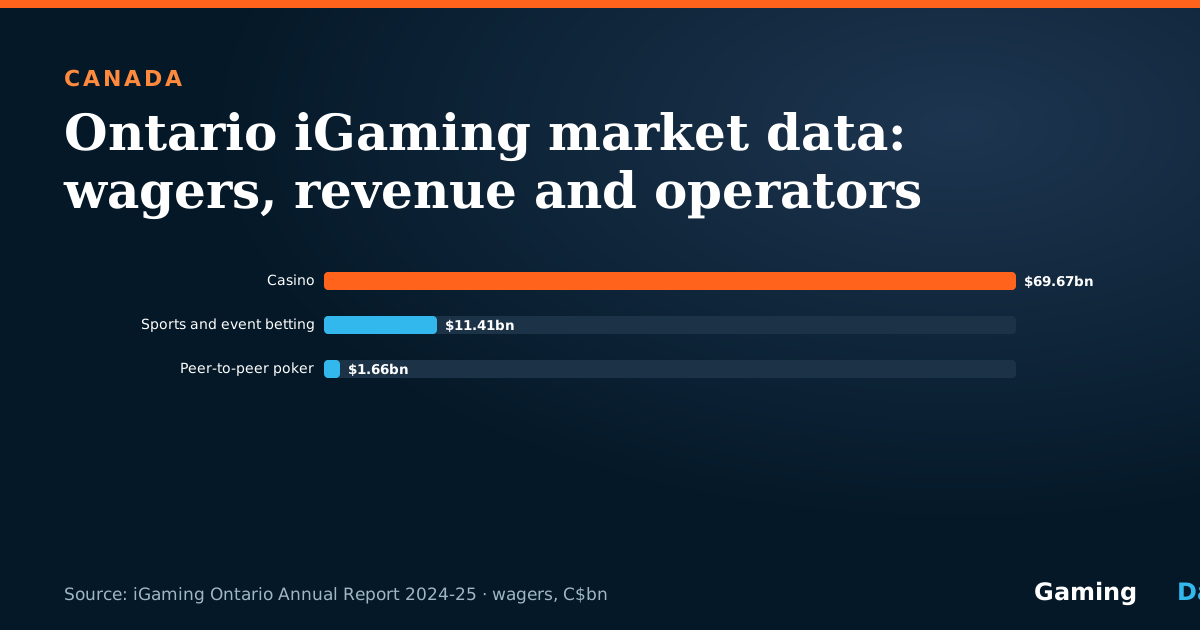
- Ontario's private regulated market reported over C$4.2 billion in gaming revenue for April 2025 to March 2026 (unaudited), far larger than any provincial lottery platform.
- Among lottery corporations, OLG.ca reported C$556 million and BCLC's PlayNow C$494 million in iGaming revenue for 2025-26.
- Alberta opened a regulated private market on 13 July 2026; no official revenue or wager figures had been published by 24 October 2026.
- Loto-Québec does not publish an online revenue figure in dollars; online was 19.2% of its 2025-26 revenue.
Online gambling revenue in Canada is reported province by province, because the Criminal Code leaves gambling to the provinces. Two provinces, Ontario and, since July 2026, Alberta, license private operators. In the others, the provincial lottery corporation runs the only legal online casino and sportsbook. The latest official figures show Ontario's private market at over C$4.2 billion in gaming revenue for its 2025-26 fiscal year, while the largest lottery platforms reported between C$30 million and C$560 million each.
Those numbers come from different kinds of report, so the table below states the basis of each. A revenue figure in a lottery corporation's financial statements is not the same measure as gross gaming revenue in a regulator's market report.
Latest online figures by province
| Province | Platform or market | Fiscal year | Online figure | Basis |
|---|---|---|---|---|
| Ontario | Private regulated market (iGaming Ontario) | 2025-26 | over $4.2bn | Gaming revenue, unaudited |
| Ontario | OLG.ca (lottery corporation) | 2025-26 | $556m | iGaming revenue, IFRS financial statements |
| British Columbia | PlayNow (BCLC) | 2025-26 | $494m | iGaming revenue by line of business |
| New Brunswick, Nova Scotia, PEI, Newfoundland and Labrador | Atlantic Lottery (alc.ca) | 2024-25 | $159.2m | iGames net revenue (sports net revenue of $13.2m is reported across all channels) |
| Manitoba | PlayNow (Manitoba Liquor and Lotteries) | 2024-25 | $76.0m | Online gaming segment revenue |
| Saskatchewan | PlayNow (SIGA) | 2025-26 | $31.6m | iGaming gross gaming revenue (trade press report of the annual report) |
| Quebec | lotoquebec.com and Mise-o-jeu+ | 2025-26 | not disclosed | Online share of total revenue: 19.2% |
| Alberta | Private regulated market (AGLC and Alberta iGaming Corporation) | Launched 13 July 2026 | not published | No official figures yet |
Reading the bases correctly
The lottery corporations publish online results inside their annual reports, and each uses its own line items. BCLC and Manitoba report revenue for the online line of business. OLG's 2025-26 financial statements give iGaming revenue under IFRS, which for 2025-26 was C$556 million, against C$585 million for 2024-25 once iLottery was moved into its lottery segment; its 2024-25 annual report also gave a gross figure for digital gaming proceeds of C$882 million, which includes iLottery and PROLINE+ sports betting. Atlantic Lottery reports net revenue. Saskatchewan's SIGA reports both gross gaming revenue (C$31.6 million) and net revenue (C$12.4 million).
If you need one comparable measure across provinces, it does not exist in published form. The safest approach is to compare each province with itself over time, which is why the table gives the basis and fiscal year rather than a ranking.
Alberta's new market
Alberta's regulated iGaming market opened on 13 July 2026, according to the provincial government. The Alberta Gaming, Liquor and Cannabis Commission registers operators, and the Alberta iGaming Corporation holds the commercial agreements. Under the published model, operators keep 80% of net iGaming revenue and the province 20%, with a further share of gross gaming revenue set aside for First Nations and for social responsibility programmes.
Before launch, the government estimated that about 70% of iGaming by Albertans took place on unregulated sites. No revenue or wager figures had been published by the regulator or the corporation when we checked, and press counts of live operators differ (from 10 companies to 28 casino sites), so we do not list one. We will add official figures when they appear.
Ontario's two channels
Ontario is the only province with two separate online channels in the data: the private market overseen by iGaming Ontario, and OLG's own site. Their figures are reported by different bodies and should be added together only with care, since iGaming Ontario's revenue is a gaming revenue measure and OLG's is an accounting revenue figure. Our Ontario market data page covers the private market in detail, including the monthly series for 2026.
The legal basis in brief
Provinces have conducted and managed lottery schemes, including online games, under the Criminal Code for many years. Single-event sports betting became possible on 27 August 2021, when the Safe and Regulated Sports Betting Act (Bill C-218), which received Royal Assent on 29 June 2021, came into force. Horse race betting remains federally regulated.
Questions about Canadian online gambling data
What is the total size of Canada's online gambling market?
No official national total is published. Ontario's private market alone reported over C$4.2 billion in gaming revenue for 2025-26, and provincial lottery platforms report several hundred million dollars more, on different bases that should not simply be added.
Has Alberta published iGaming revenue figures?
Not as of 24 October 2026. The market launched on 13 July 2026, and neither the regulator nor the Alberta iGaming Corporation had released revenue or wager data.
Why is there no figure for Quebec?
Loto-Québec reports online revenue within its casino and gaming segment and discloses only the online share of total revenue, which was 19.2% in 2025-26.
Sources
- iGaming Ontario: FY2025-26 totals (21 May 2026)
- OLG: Consolidated Financial Statements 2025-26; OLG Annual Report 2024-25
- BCLC: Annual Service Plan Report 2025/26
- Atlantic Lottery: Annual Report 2024-25
- Manitoba Liquor and Lotteries: Annual Report 2024-25
- Gaming Intelligence: SIGA 2025-26 results (25 June 2026; secondary)
- Loto-Québec: Rapport annuel 2025-2026 (3 June 2026)
- Government of Alberta: Alberta's iGaming strategy; iGaming fact sheet (13 January 2026)
- Canada Gazette: SI/2021-56, coming into force of the Safe and Regulated Sports Betting Act