- The Netherlands raised its gambling tax to 34.2% on 1 January 2025 and to 37.8% on 1 January 2026, charged on gross gaming revenue.
- Denmark taxes online casino at 28% of gross gaming revenue; Sweden charges 22% on all licensed gambling since 1 July 2024.
- Finland's licensed market will pay 22% of gross gaming revenue when it opens on 1 July 2027.
- Germany taxes online slots and poker at 5.3% of stakes, a different base that makes its rate look low but is not.
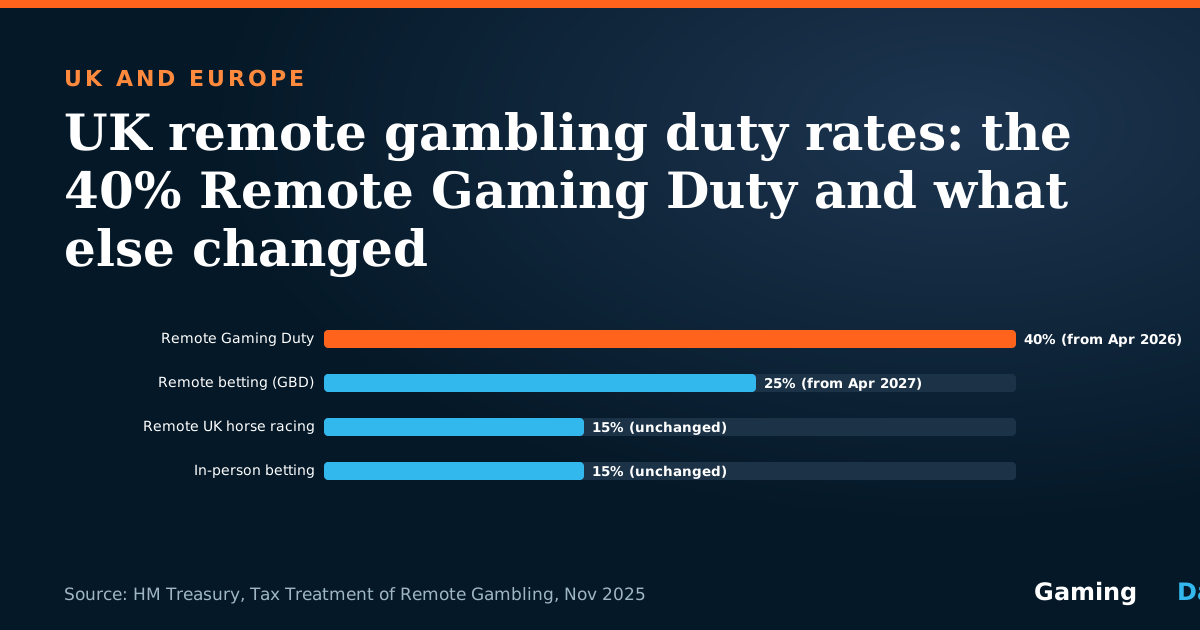
Online gambling tax rates in Europe range from 11% of gross gaming revenue in Belgium to 37.8% in the Netherlands for 2026, and 40% for online casino in the United Kingdom. The comparison only works when the base is the same. Most countries tax gross gaming revenue, which is stakes minus winnings. Germany taxes the stake itself, and Ireland taxes betting turnover, so their headline rates measure something else.
We list a rate as verified only when we read it in a tax authority, parliament or regulator document. Rates reported only by law firms or trade press are marked, and those we could not confirm are left out of the chart.
Rates by market
| Market | Rate | Charged on | Recent change | Status |
|---|---|---|---|---|
| United Kingdom, online casino | 40% | Remote gaming profits | Up from 21% from April 2026 | Verified (HM Treasury) |
| United Kingdom, online betting | 15%, then 25% | Betting profits | 25% from 1 April 2027; UK horse racing stays 15% | Verified (HM Treasury) |
| Netherlands | 37.8% | Gross gaming revenue | 30.5% to 34.2% (1 Jan 2025) to 37.8% (1 Jan 2026) | Verified (Ksa and Ministry of Finance) |
| Denmark, online casino | 28% | Gross gaming revenue | Up from 20% on 1 January 2021 (law firm) | Rate verified (tax guidance); history secondary |
| Sweden | 22% | Stakes minus payouts, monthly | Up from 18% on 1 July 2024 | Verified (Riksdag) |
| Finland | 22% | Stakes minus winnings | Applies from 1 July 2027, when licensing starts | Verified (Eduskunta) |
| Belgium | 11% | Gross margin on online bets and games | Flanders has proposed 15% from 2027 (not enacted) | Wallonia verified; others secondary |
| Germany, online slots and poker | 5.3% | Stakes | In force since July 2021 | Verified (Bundestag) |
| Italy | 24.5% betting, 25.5% casino | Gross gaming revenue, plus 3% fee on net revenue | New concessions from late 2025 | Law firm only |
| Greece | 35% | Gross gaming revenue | Set with the 2020 licensing regime | Secondary (2020 report) |
| Poland, online betting | 12% | Stakes | Online casino is a state monopoly | Law firm only |
| Ireland, betting | 2% | Turnover | Doubled from 1% in Budget 2019 | Law firm only (2020) |
| Spain, France, Portugal | not listed | Gross gaming revenue (Spain); varies | France changed rates on 1 July 2025 | Not verified; sources conflict |
The Dutch increases and what followed
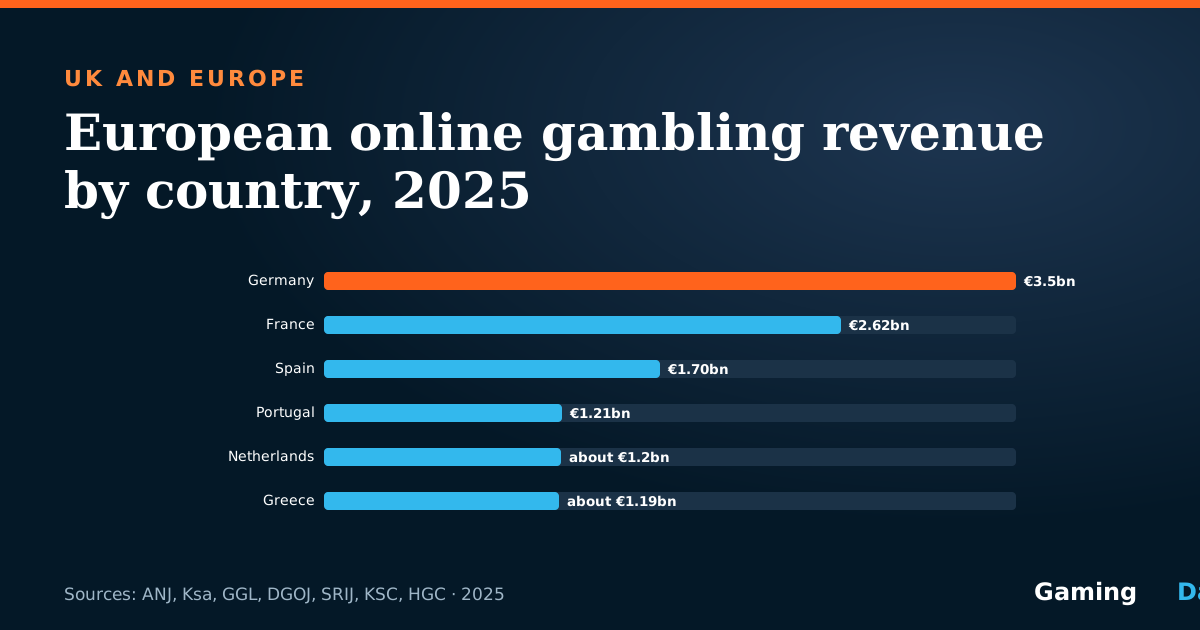
The Netherlands raised its rate twice in 12 months. The government's own monitoring of the change, published in June 2026, records the rate path and the first-quarter 2026 online revenue of €321 million. Over 2025, online gross gaming revenue fell 18.5%, and the regulator estimated the licensed share of gross gaming revenue at 53% in the second half of the year. Tax is not the only factor behind those numbers: the Netherlands banned untargeted gambling advertising from July 2023 and introduced monthly net deposit caps from October 2024 (€700, or €300 for young adults, unless an affordability check is passed). Our European revenue table has the market figures.
Why Germany's 5.3% is not a low rate
A tax on stakes applies to every euro bet, not to what the operator keeps. If an online slot pays back 95% of stakes over time, the operator's gross revenue is 5% of stakes, and a 5.3% tax on stakes would exceed it. That is why operators have to set lower payout rates in Germany than in markets that tax revenue, and why channelisation is a common concern there. To compare Germany with other markets, convert its rate using the actual payout ratio, which varies by game.
Finland's opening
Finland's Gambling Act (10/2026) ends Veikkaus's monopoly on online casino and betting. The National Police Board began accepting licence applications on 1 March 2026, and the licensed market starts on 1 July 2027, at a 22% tax on stakes minus winnings. Veikkaus keeps lotteries, scratch cards and physical slots and casino games.
Questions about European gambling taxes
What is the gambling tax rate in the Netherlands in 2026?
37.8% of gross gaming revenue from 1 January 2026, up from 34.2% in 2025 and 30.5% before that.
How is online casino taxed in Germany?
Virtual slots and online poker are taxed at 5.3% of stakes under the federal law on betting and lotteries, in force since July 2021. Because the base is stakes, not revenue, the effective burden is much higher than the rate suggests.
Which European country taxes online gambling most heavily?
On revenue-based rates, the UK's 40% Remote Gaming Duty and the Netherlands' 37.8% are the highest in this table. Stake-based taxes like Germany's can be heavier in practice.
Sources
- HM Treasury and HMRC: The Tax Treatment of Remote Gambling, government response (November 2025)
- Netherlands: Monitor effecten verhoging Kansspelbelasting (June 2026)
- Denmark: Den juridiske vejledning E.A.9.8, gambling duty (mirror of SKAT guidance); Bird & Bird on the 2021 increase (secondary)
- Riksdag: Skatteutskottets betänkande 2023/24:SkU19, höjd spelskatt (16 April 2024)
- Eduskunta: HaVM 28/2025 vp; Borenius guide to Finland's new regime (28 May 2026; secondary)
- Wallonie Finances: tax on games and bets (updated 27 May 2026); SiGMA on Belgian regional rates (secondary)
- Bundestag: hib 485/2021 on the 5.3% tax on virtual slots and online poker
- DLA Piper: Italian online gambling licences (29 September 2025; secondary)
- WH Partners via Mondaq: gambling laws in Poland (30 December 2025; secondary)
- A&L Goodbody: Irish betting duty (27 February 2020; secondary)
- iGB: Greek online licence process and tax (8 October 2020; secondary)